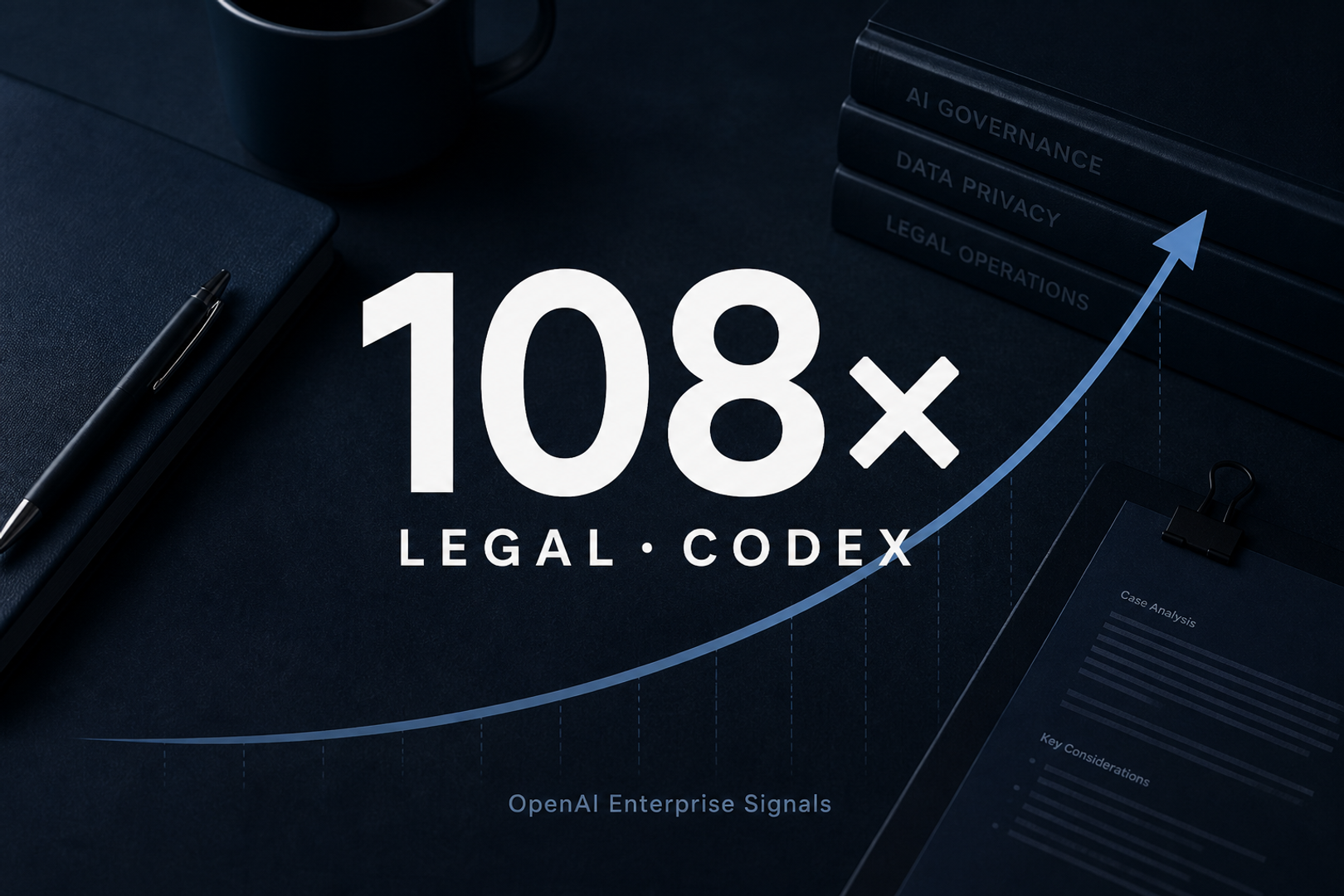
OpenAI Data: Legal Codex Users Grew 108× — What Firms Should Take From It
Legal Codex usage jumped ~108×—what firms should take next: citation-verified research and playbook review on matter files, with on-premise or cloud deployment that fits confidentiality rules.
- legal AI
- OpenAI
- Codex
- enterprise AI
- knowledge work
- Hong Kong
OpenAI’s Enterprise Signals report shows that weekly active enterprise Codex users in legal roles grew roughly 108× from a 1 February 2026 baseline through mid-year—well ahead of engineering’s about 5×. Andreessen Horowitz later highlighted the same series in its Charts of the Week. For law firms, the useful question is not whether the chart draws attention, but what a relative adoption index does—and does not—say about practice.
Source and republication
The primary figures come from OpenAI Enterprise Signals, also summarised in From assistance to execution: How enterprises put AI to work (about 12 August 2026). OpenAI reports aggregated, de-identified enterprise usage.
On 21 August 2026, a16z Charts of the Week: Winds of Thematic Change republished the Legal/Codex growth chart, noting that knowledge work—especially legal—has been driving frontier usage more recently. OpenAI published the measurement; a16z amplified distribution among investors and operators.
What the numbers show
Weekly active enterprise Codex users by job title, indexed to 1 February 2026 (through roughly June):
Legal — 108×
Fastest relative growth among enterprise job categories in the Codex series.
Sales & Recruiting — 41×
Tied for second: account/sales and people/recruiting functions.
Marketing — 26×
Marketing / communications also rose sharply off the February baseline.
Engineering — 5×
Still growing—but the slowest relative rise after early, heavy adoption.
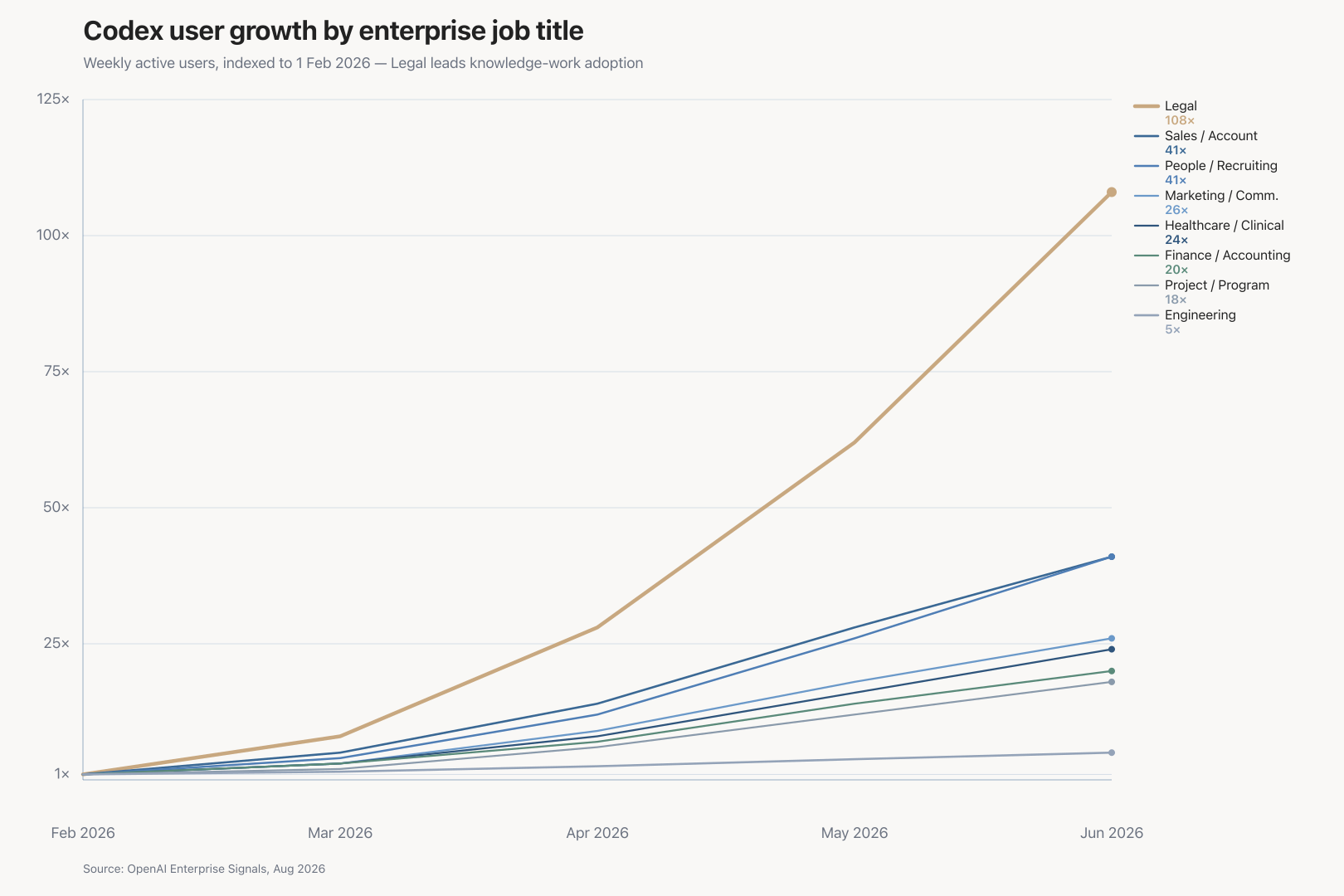
OpenAI’s fuller ladder also lists healthcare/clinical (~24×), finance/accounting (~20×), and project/program roles (~18×). The pattern is consistent: document- and workflow-heavy knowledge roles show the steepest relative Codex adoption.
Reading relative indices
108× does not mean lawyers became 108 times more productive, nor that legal now has more Codex users than engineering in absolute terms.
Each category is measured against its own February baseline. If legal started from a small base and engineering was already saturated with early adopters, legal’s multiple can look dramatic while engineering’s 5× still represents a large absolute headcount. a16z notes that broader Codex rollout timing may amplify the shift.
Treat the chart as evidence of diffusion—agentic tools moving into non-engineering work—not as a ranking of ROI or accuracy.
The broader Enterprise Signals picture
The Legal series is one finding; the surrounding report supplies the operating context:
Frontier gap: 8.3×
Top-decile “frontier” firms generate ~8.3× output tokens per active user vs typical firms (up from ~2.6× in January).
Agentic share: ~64%
As of June, Codex accounted for about 64% of combined Codex + ChatGPT enterprise output tokens—a proxy for delegated, multi-step work.
OpenAI’s framing is that enterprise AI is moving from answering questions to carrying out work. Depth of use—not mere seat access—is where the gap compounds.
Why legal work fits agentic tools
Legal work is long-context, rule-bound, and review-heavy: contracts, opinions, diligence packs, correspondence, and policy. That is the class of workflow where agents can draft, compare, and iterate—if lawyers remain on the verification loop.
The risk for firms is mistaking general coding agents for legal research and review systems. Fluency without jurisdiction-aware retrieval and citable sources remains a drafting hazard. See why firms need enterprise RAG for legal research and AILexSys legal research.
Implications for Hong Kong and APAC counsel
- Plan for non-engineer demand. Training, permissions, and review playbooks matter as much as model choice.
- Measure depth, not seats. Frontier vs typical usage gaps suggest governance and workflow design decide who pulls ahead.
- Keep authority in the loop. For HK matters, grounded answers from Judiciary / e-Legislation and matter files beat generic agent output—pair research with contract review where playbooks encode firm risk tolerance.
- Deployment still matters. Client and regulatory expectations may require on-premise or tightly scoped cloud—see adopting legal AI without giving up data control.
Bottom line
As relative Codex adoption data from OpenAI, the Legal 108× series is a credible signal that agentic AI is entering knowledge work fastest where documents and workflows dominate. It is not evidence that lawyers outpace engineers on absolute usage or outcomes.
Firms that turn that adoption into governed, citable, jurisdiction-aware practice will be better placed than those that chase the multiple alone.
Next steps: Explore legal research and contract review, or sign in to test matter-scoped workflows.
Sources
- Enterprise Signals — OpenAI
- From assistance to execution: How enterprises put AI to work — OpenAI
- Charts of the Week: Winds of Thematic Change — a16z (21 Aug 2026)